

Swallowing should be effortless. When it becomes painful, most people assume they have a throat infection. But if the discomfort is on one side, is worse near the back of your jaw, and has arrived alongside a dull ache or swollen gum, your wisdom teeth may be behind it.
Wisdom tooth pain when swallowing is more common than many people realise. The back molars sit close to the throat muscles and soft tissue involved in swallowing, so when infection or inflammation develops in that area, it can affect movement that normally happens without thought. Understanding what is driving the pain shapes what needs to happen next.
Quick Overview
- Wisdom tooth pain when swallowing is often linked to a partially erupted or impacted wisdom tooth causing inflammation in nearby tissue
- This may apply to anyone in their late teens or twenties experiencing one-sided throat discomfort, jaw stiffness, or swollen gums near the back of the mouth
- The underlying cause can range from a minor gum irritation to a spreading infection that requires prompt attention
- How the pain presents, whether it is worsening, and whether systemic symptoms are present all influence how urgently the situation needs to be assessed
- Keep reading to understand the specific causes, warning signs, and when to seek dental care
Why Do Wisdom Teeth Cause Pain When Swallowing?
Wisdom teeth, also known as third molars, are the last teeth to emerge. They typically appear between the late teens and mid-twenties, at a time when there is often insufficient space in the jaw for them to erupt cleanly. When a wisdom tooth is only partially through the gum, a flap of gum tissue forms over the crown of the tooth. This flap, called an operculum, creates a pocket where food particles and bacteria accumulate. The result is inflammation that can extend beyond the tooth itself into the nearby soft tissue, jaw muscles, and throat area.
The muscles used for swallowing sit close to the lower wisdom teeth in particular. When inflammation develops in that region, the act of swallowing, which involves coordinated movement of those muscles, can become uncomfortable or painful. The pain may feel like it is coming from the throat, which is why wisdom tooth problems are sometimes mistaken for a standard sore throat or tonsillitis.
What Is Pericoronitis?
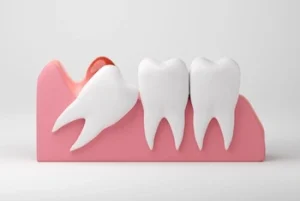 Pericoronitis is the most common cause of wisdom tooth pain when swallowing. It is an infection or inflammation of the gum tissue surrounding a partially erupted wisdom tooth.
Food and bacteria collect under the gum flap and cause infection when there is not enough jaw space for the tooth to fully emerge. Pericoronitis most often affects the lower wisdom teeth because these are the last to emerge and the most likely to become impacted. Symptoms can range from mild gum soreness and a bad taste in the mouth to severe pain that spreads to the jaw, ear, and throat, combined with difficulty swallowing and limited mouth opening.
Pericoronitis can be acute, arriving suddenly with significant swelling and pain, or chronic, where the gum remains mildly inflamed and flares up repeatedly over time. Recurring episodes are a strong indication that the underlying tooth needs to be assessed.
Other Causes of Wisdom Tooth Pain When Swallowing
Pericoronitis is the most frequent cause, but other wisdom tooth-related issues can also produce swallowing pain:
- Impacted wisdom teeth. A wisdom tooth that is partially or fully stuck beneath the jawbone or gum tissue creates ongoing pressure on surrounding structures. This pressure can irritate nearby nerves and soft tissue, generating pain that radiates into the throat area.
- Spreading infection. If a pericoronitis infection is not treated, it can move into the surrounding tissues of the jaw, cheek, and neck. As the infection spreads, swallowing becomes more difficult and painful, and the risk of serious complications increases.
- Swollen lymph nodes. The lymph nodes beneath the jaw are part of the body’s response to infection in the mouth. When a wisdom tooth is infected, these nodes often become tender and swollen, adding to the discomfort felt when swallowing.
- Abscess formation. An untreated infection around a wisdom tooth can develop into a dental abscess. Infection, pain, and swelling from an impacted wisdom tooth can escalate and make swallowing very difficult.
- Jaw stiffness (trismus). Severe inflammation or infection near a lower wisdom tooth can cause the jaw muscles to tighten and stiffen. This restriction affects both mouth opening and the normal movement involved in swallowing.
Signs That Your Wisdom Tooth Situation Needs Prompt Attention
Not every wisdom tooth causes problems, and not every episode of discomfort in the back of the mouth requires urgent care. But certain signs indicate the situation is escalating and needs to be assessed without delay:
- Pain when swallowing that is worsening or has been present for more than two days
- Visible swelling in the gum behind your last molar
- Swelling in the cheek, jaw, or neck
- Bad breath or an unpleasant taste that does not clear with rinsing
- Difficulty opening your mouth fully
- Swollen or tender lymph nodes under the jaw
- Fever or a general feeling of being unwell
- Pus or discharge from the gum near the affected tooth
Any combination of swallowing difficulty, fever, and facial swelling should be treated as urgent. These symptoms can indicate that an infection is spreading beyond the mouth, which requires prompt dental assessment and may need antibiotic treatment. If swelling is affecting your ability to breathe or swallow completely, seek emergency care immediately.
How Wisdom Tooth Pain When Swallowing Is Assessed and Treated
A dentist will assess the area with a clinical examination and, where appropriate, dental X-rays. X-rays help identify whether the tooth is impacted, whether there is bone involvement, and what position the tooth is in relative to adjacent structures. The findings will guide the recommended treatment.
Treatment options depend on the cause and severity:
- Cleaning and irrigation. For mild pericoronitis, a dentist can clean the area beneath the gum flap, remove trapped food debris, and irrigate the pocket to reduce bacterial load. This can relieve acute symptoms.
- Antibiotics. Where infection has spread, or systemic symptoms are present, antibiotics may be prescribed. Antibiotics alone do not resolve the underlying cause, so dental treatment is still needed.
- Warm salt water rinses. Gently rinsing with warm salt water several times a day can help reduce inflammation in the short term. This is supportive care, not a replacement for treatment.
- Pain relief. Over-the-counter paracetamol or ibuprofen, taken according to packet directions, can help manage discomfort while awaiting dental care.
- Wisdom tooth extraction. Where the tooth is impacted, the infection is recurring, or there is not enough space for the tooth to erupt cleanly, removal is often the definitive solution. Early removal prevents symptoms from returning and eliminates the environment in which bacteria accumulate. Extraction may be performed under local anaesthetic in a dental clinic; more complex cases may require referral.
- Gum flap removal (operculectomy). In some cases where the tooth is expected to erupt fully, removing the gum flap covering it can eliminate the pocket where bacteria collect.
What Happens If Wisdom Tooth Pain When Swallowing Is Left Untreated?
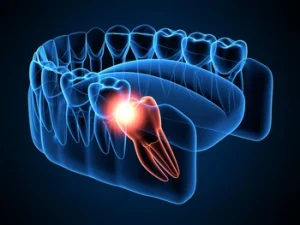 Ignoring wisdom tooth pain when swallowing carries real risk. Pericoronitis that is not treated can escalate into a spreading infection involving the jaw, neck, and surrounding soft tissue. In serious cases, this can affect the airway.
Early assessment of impacted wisdom teeth prevents complications. The longer an impacted wisdom tooth remains, the more established the roots become, and the more complex removal may be.
Pain that has settled on its own does not mean the problem has resolved. Pericoronitis commonly recurs, and each episode can be more severe than the last.
A Considered Approach to Wisdom Tooth Pain in Adelaide
Wisdom tooth pain when swallowing is not something to manage with salt water rinses and hope. If swallowing has become painful, if swelling is present near the back of your jaw, or if symptoms have lasted more than a day or two, dental assessment is the right next step.
We are available from 7 am to 9 pm, seven days a week, including weekends and public holidays. If you are experiencing wisdom tooth pain or difficulty swallowing, call us on (08) 7078 8263 or book an appointment online.
Note: Any surgical or invasive procedure carries risks. Before proceeding, you should seek a second opinion from an appropriately qualified health practitioner.
Frequently Asked Questions
Can a wisdom tooth really cause pain when swallowing?
Yes. The lower wisdom teeth sit close to the muscles and soft tissue involved in swallowing. When infection or inflammation develops around a partially erupted wisdom tooth, it can directly affect the ability to swallow comfortably. The pain is often felt on one side and may be mistaken for a sore throat or tonsillitis.
What is pericoronitis and how does it cause swallowing pain?
Pericoronitis is an infection of the gum tissue around a partially erupted wisdom tooth. When bacteria accumulate under the gum flap covering the tooth, infection develops, and the surrounding tissue becomes swollen and inflamed. Because this tissue is close to the throat and jaw muscles, swallowing can become painful. The pain may also spread to the ear, jaw, or neck on the affected side.
How do I know if my wisdom tooth pain when swallowing is serious?
Signs that require prompt dental attention include swelling in the cheek or jaw, fever, difficulty opening the mouth fully, swollen lymph nodes beneath the jaw, pus or discharge from the gum, and swallowing pain that is worsening or has persisted for more than two days. Swelling that affects breathing should be treated as a medical emergency.
What causes a sore throat after wisdom tooth removal?
A sore throat following wisdom tooth removal is common and usually settles within a few days. It is caused by irritation to the throat muscles and surrounding tissue during the procedure, as well as post-operative swelling in the area. Keeping up with soft foods, gentle salt water rinses, and over-the-counter pain relief typically helps manage discomfort during recovery. If a sore throat worsens after the first few days or is accompanied by fever or swelling, a dentist should be contacted.
How do I know if my throat pain is from my wisdom teeth or tonsillitis?
Wisdom tooth-related throat pain is usually one-sided, located toward the back of the jaw, and accompanied by other dental symptoms such as swollen gums, difficulty opening the mouth, or a bad taste near the affected tooth. Tonsillitis tends to produce pain across both sides of the throat, visible redness or white patches on the tonsils, and sometimes swollen glands in the neck without localised jaw discomfort. If you are unsure, a dentist can examine the wisdom tooth area and help determine whether the throat pain has a dental origin.
References
Better Health Channel, Department of Health Victoria. (2022). ‘Wisdom teeth’. Better Health Channel, 3 June. Victoria: Department of Health Victoria. https://www.betterhealth.vic.gov.au/health/conditionsandtreatments/wisdom-teeth
SA Dental, Government of South Australia. (n.d.). ‘Wisdom teeth’. SA Dental. Adelaide, SA: Government of South Australia. https://www.dental.sa.gov.au/advice/wisdom-teeth
Healthdirect Australia. (2026). ‘Removing wisdom teeth’. Healthdirect Australia, January. Australia: Healthdirect Australia. https://www.healthdirect.gov.au/surgery/removing-wisdom-teeth
Australian Dental Association. (n.d.). ‘Wisdom teeth’. Teeth.org.au. St Leonards, NSW: Australian Dental Association. https://www.teeth.org.au/wisdom-teeth